Before we audit a client's site, we run the same checklist on our own. If we can't pass it, we don't ship it. Lately we've also started running it on the agencies that show up when you ask an AI engine who's the best AI marketing agency, not to dunk on anyone, but because it's the fastest way to show what the audit actually measures.
This time the specimen was the one you already know. The award-shelf, the logo wall stacked with household-name brands you’d recognize in a heartbeat, the permanent slot at the top of every “best AI marketing agency 2026” roundup. The agency that turns up first when a CMO asks an AI engine who leads enterprise AI marketing. We’ll call them “Reelpolks” — you can fill in the blank — because the point of this post isn’t who they are. The point is what the checklist finds even on a site this celebrated.
So this isn’t a story about a weak agency. It’s the opposite. “Reelpolks” is a category leader, and genuinely excellent at what they’re famous for. It’s a story about how a strong, well-regarded brand can still leave its own front door — the homepage an AI engine actually reads — under-optimized for the exact discovery layer it sells into.
Every finding below is taken from their live, public homepage. No private data, no guesswork, no claims about their work or their results. Just the checklist, applied honestly.
The setup: what we’re actually testing
Our audit doesn’t grade vibes. It checks whether a page is structured to be read, extracted, and cited — by Google’s crawler and, increasingly, by the AI engines (ChatGPT, Perplexity, Gemini, Google AI Overviews) that now answer a growing share of buyer questions before a link is ever clicked.
That distinction matters more every quarter. As an AEO agency and generative engine optimization agency, we live in this distinction. When a buyer asks an AI engine “best AI marketing agency for enterprise CPG,” the engine doesn’t render the parallax animation or play the hero video. It reads the text, the headings, and the structured data. If the substance of your page lives inside images, motion, and modals, the engine sees a beautiful, near-empty room.
Five checks. Every one of them is something we’d flag — and fix — on a client site in week one.
Finding 1 — The headline an engine reads isn’t a headline. It’s a row of pictures.
The “Reelpolks” homepage hero spells out the brand name using individual SVG image-letters — one graphic per letter — rather than real heading text. It looks sharp. It animates beautifully. And to a crawler or an AI retrieval system, it’s close to invisible, because there’s no actual <h1> text string carrying the brand and the primary keyword.
Why it costs
The single most important on-page signal — the H1 — is the page telling search and AI systems “this is what I’m about.” When that signal is rendered as decorative images, you forfeit it. For a site whose entire value proposition is being found by AI, that’s the most expensive place to lose it.
The fix: Render the hero brand and value statement as real text, styled to look exactly as designed. Keep the visual; recover the signal. A 1–2 hour change.
Finding 2 — No structured data. The engines are guessing who they are.
We found no Organization schema, no WebSite schema, no sameAs entity links on the homepage. Structured data is how you tell an AI engine, in a language it parses natively: this is the organization, here’s its name, here’s its logo, here are its verified social and entity profiles, trust this as a single coherent entity.
This is the entity knowledge graph gap that answer engine optimization is specifically designed to close. Without schema, an engine has to infer the entity from scattered text and third-party mentions.
Why it costs
“Reelpolks” gets away with this today only because their off-site reputation — awards, press, a decade of enterprise work — is strong enough to do the entity work the site itself isn’t doing. Strip away the legacy authority and the on-page foundation wouldn’t hold it up. That’s not a position you’d want a client to depend on.
The fix: Add Organization + WebSite + sameAs schema. A few hours of work that makes the brand legible to the systems it’s trying to win.
Finding 3 — The substance is locked in modals and motion.
A large share of the homepage’s actual words — the part an engine can extract — sits inside pop-up modals, animated reveals, and image-rendered text. We also found a stack of legacy event content (webinars dated 2023–2024) still loaded in the page’s DOM long after the events ended.
Why it costs
Two problems at once. First, content trapped in interaction layers is content an AI engine may never surface, because it reads the extractable text, not the choreography. Second, stale event content dilutes topical relevance — the page is partly “about” webinars that happened two years ago, which is not the signal you want anchoring an authority play.
The fix: Surface the core value proposition as clean, crawlable body copy. Archive or remove the dead event modals. Let the page be about what the agency does now.
Finding 4 — Image alt text is largely missing.
The client logos, the award badges — the very assets that carry the trust signal — are mostly served without descriptive alt text. To a sighted visitor, those world-famous brand logos are an instant credibility hit. To an engine (and to a screen reader), they’re unlabeled image files.
Why it costs
Those logos are arguably the strongest trust evidence on the page. Unlabeled, they pass that evidence to humans and withhold it from machines — including the AI systems deciding which agencies to name. You’ve done the hard part (winning the clients) and skipped the trivial part (telling the engine you did).
The fix: Descriptive alt text on every logo and award. An hour, maybe less. One of the highest ratio-of-impact-to-effort fixes that exists in answer engine optimization.
Finding 5 — Real users are failing Core Web Vitals on this page.
This is the finding we refuse to guess on, so we pulled two independent readings from Google’s own tools — and made sure we were reading them right.
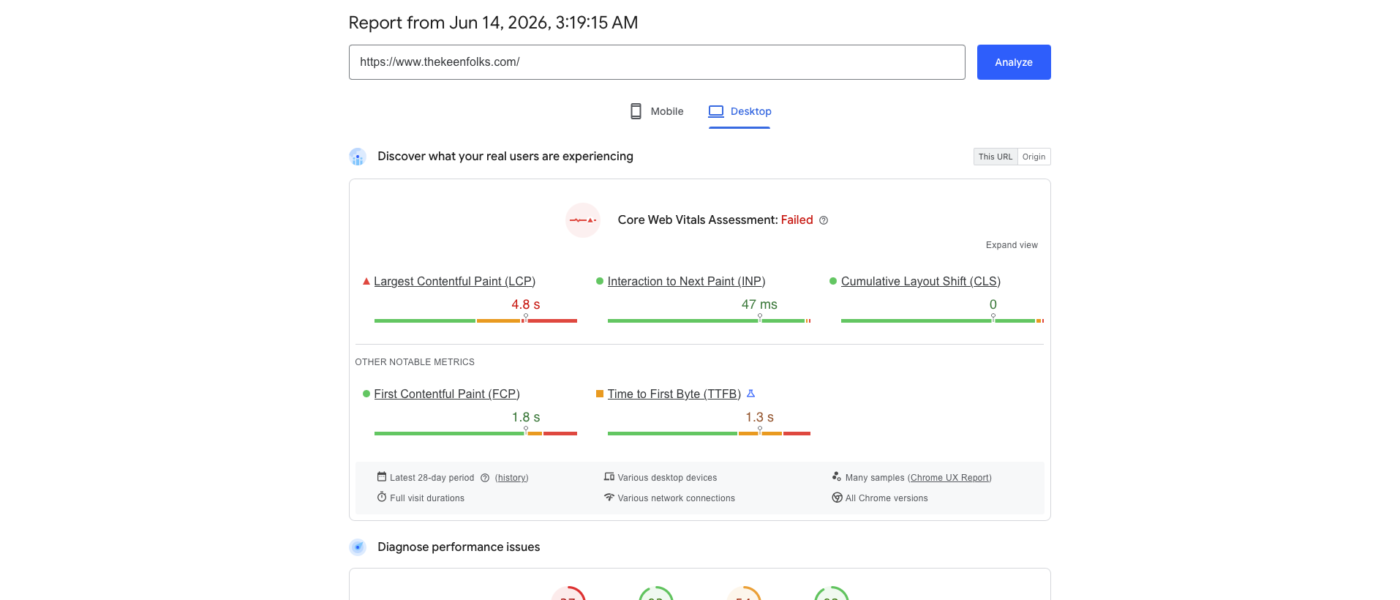
Real-world field data (Chrome User Experience Report — actual visitors over the 28-day window ending June 12, 2026): for this homepage URL, the Core Web Vitals assessment fails, driven entirely by Largest Contentful Paint at 4.8 seconds — well into the band Google flags as poor. The other two vitals are pristine — interactivity (INP 47ms) and layout stability (CLS 0). So this isn’t a broken or sloppy site. It’s a heavy one: a single metric, load speed, is failing real users.
A note on reading the report honestly: PageSpeed lets you toggle between “This URL” and “Origin.” The origin-level view — the whole domain averaged across all its pages — looks healthier. But the page a buyer actually lands on, the homepage, is the one failing. We’re reporting the page, not the flattering average.
Lab data (Google Lighthouse, controlled test on a simulated mid-range phone): a mobile Performance score of 32/100, with LCP ballooning dramatically under load and Total Blocking Time near 2,800ms. Desktop in the lab is barely better — 37/100. Two different Google tools, same verdict: this page is too heavy.
Why it costs
Page experience is a ranking factor, and a slow first paint quietly taxes everything downstream — rankings, bounce, conversions — on the exact surface where most discovery now happens. A buyer asking their phone “best AI marketing agency” lands on the page that’s struggling most.
The fix: Defer or lazy-load the hero media, compress aggressively, and protect the LCP element. Then re-measure against real field data — not a one-time lab score. Measure first, fix what the measurement shows, verify it held.
Field data: Google CrUX, “This URL” view, 28-day window ending Jun 12, 2026. Lab data: Google Lighthouse, captured Jun 14, 2026. Both are Google’s own measurements, reproducible by anyone at pagespeed.web.dev.
The point isn’t that “Reelpolks” is bad. It’s that unmeasured is unmeasured.
Here’s the honest read: “Reelpolks” is a strong agency that ranks well largely because the rest of the internet vouches for them — awards, press, a decade of enterprise work, a permanent slot in the roundups. Their off-site authority is real, and it’s carrying their on-site gaps.
That works right up until it doesn’t. AI search doesn’t reward legacy the way ten years of Google did. It rewards entities that are structured, extractable, and corroborated — measured weekly, not assumed. This is exactly what a generative engine optimization agency is built to do: engineer that entity presence and track it so you know when it moves.
A brand can be famous and still be quietly under-cited because its own page never told the engines what it told the humans. It can also be famous and still serve a failing page experience to the buyers searching for it — and never know, because nobody on the account is watching the field data.
Every finding above is a thing we’d catch on a client’s site before we’d let it ship — because we run the checklist, we instrument the page, and we re-measure. Not “we improved your AI presence.” The date you became the answer.
This isn’t the only site we’ve run the checklist on in public — we also audited an AI SEO platform’s own SEO page, and we hold our own AEO & GEO service page to the same standard. Want the same five checks on your homepage? Get a founder-signed rapid audit in 48 hours — the five checks above plus your live AI citation baseline across ChatGPT, Perplexity, and Gemini.
Methodology note: Every finding in this post is drawn from a publicly accessible agency homepage as of June 2026, observed without authentication. We make no claims about the agency’s client work, internal performance, or results — only about on-page structure that any visitor can verify for themselves. We hold our own site to the same checklist, and we publish those findings too.
MAD1SON FOUNDRY — Foundry OS® · Penalty-Proof Promise™
FAQ
Questions this post answers
Why does on-page SEO still matter if an agency already ranks well?
Off-site authority — awards, press, backlinks — can carry strong rankings even when a homepage is poorly structured. But AI search engines cite entities that are structured, extractable, and corroborated. A page that hides its substance in images, motion, and modals gives AI engines little to extract, leaving the brand dependent on legacy authority that AI retrieval does not reward the way classic search did.
What is the most common technical SEO mistake on agency homepages?
Rendering the hero headline and brand name as images or SVG letters instead of real heading text, which forfeits the H1 signal; missing Organization and WebSite structured data, which leaves AI engines guessing at the entity; and heavy above-the-fold media that fails Core Web Vitals on mobile. All three are common and all three are fixable in hours.
How do you measure whether a website fails Core Web Vitals?
Use Google’s own data, not estimates. Field data from the Chrome User Experience Report reflects real visitors over a rolling 28-day window; lab data from Lighthouse simulates a load on a controlled device and network. Read the page-level view, not the flattering origin-wide average — a specific landing page can fail Core Web Vitals on real users even when the domain average looks healthier, usually when heavy above-the-fold media inflates Largest Contentful Paint.