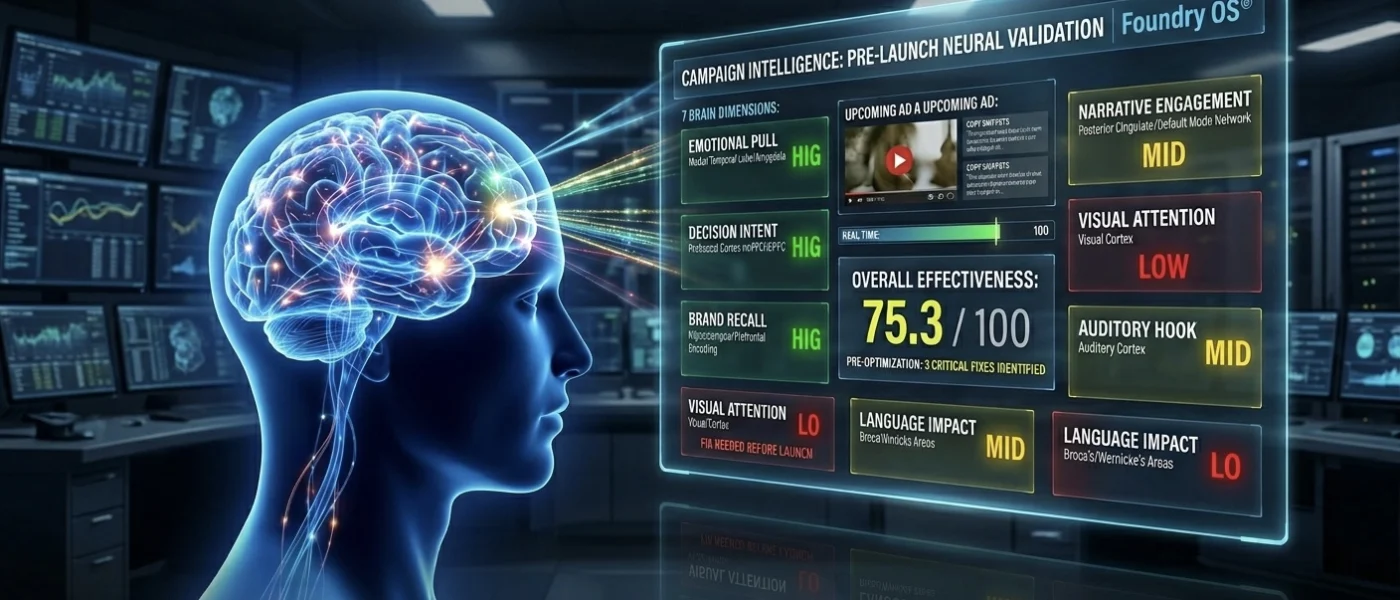
Before a single dollar of media budget is spent, we already know if the ad will work.
Every ad we create at MAD1SON FOUNDRY goes through Campaign Intelligence, our proprietary neuro-validation system built into Foundry OS™. It tells us, with measurable precision, how the human brain responds to your creative across 7 critical dimensions. We know what’s working, what isn’t, and exactly what to fix, before you’ve paid for a single impression.
No other growth systems firm in the world walks into a client meeting with a pre-launch neurological effectiveness score. That’s not a positioning claim. It’s a structural advantage, and this post explains exactly what it means for you.
The Problem With How Advertising Works Today
Here is how almost every growth team runs an ad campaign: they create the creative based on experience, instinct, and brand guidelines. They launch. They wait. Then, after spending $20,000, $50,000, or $200,000 on media, they look at the performance data and figure out what worked.
That’s not optimization. That’s paying to run an experiment you could have run before the budget dropped.
The advertising industry has always had a measurement problem, not a lack of data after the fact, but a fundamental inability to predict performance before the spend. Brands have accepted this as a cost of doing business. A/B testing helps. Focus groups help a little. But both happen after significant investment, and neither gets close to the actual neural response of a real human encountering your ad in the wild.
Campaign Intelligence changes this entirely.
What Campaign Intelligence Actually Measures
Campaign Intelligence runs every ad, video, audio, or copy, through a neural prediction model that simulates how 7 regions of the human brain respond to the content. These aren’t abstract scores. Each dimension maps to a specific brain region and a specific business outcome.
The 7 Brain Dimensions
Emotional Pull, measured via the medial temporal lobe and amygdala proxy. This tells us whether your ad makes people feel something. Emotional resonance is the single strongest predictor of purchase behavior and long-term brand memory. An ad that doesn’t trigger emotional response is an ad that doesn’t convert, regardless of how much you spend pushing it.
Decision Intent, measured via the prefrontal cortex, specifically the vmPFC and dlPFC. This is the buy signal. When Decision Intent is high, the brain is actively moving toward action. When it’s low, the viewer is passive, watching but not moving. We want this number high before launch, not after a six-figure media spend tells us it wasn’t.
Brand Recall, measured via hippocampal and prefrontal encoding. Will they remember you after the scroll? High Brand Recall means the brand encodes into memory during the ad experience, critical for products with a longer purchase cycle, where the conversion window is weeks or months after first exposure.
Narrative Engagement, measured via the posterior cingulate cortex and default mode network. Is the brain actually “in” the story? High engagement means lower skip rates, higher completion, and stronger brand association. Low engagement means the viewer’s mind has wandered, they’re watching your ad without experiencing it.
Visual Attention, measured via the primary and extrastriate visual cortex. Does the visual actually capture and hold the eye? This is where most brands leave the most points on the table. Beautiful creative that doesn’t arrest the visual system is creative that doesn’t register. If Visual Attention is low, we fix it in the studio before it goes to media.
Auditory Hook, measured via the superior temporal and auditory cortex. Does the sound design, music, or voiceover actually land in the brain’s auditory processing center? Audio that doesn’t register neurologically is audio that doesn’t reinforce the message, regardless of how good it sounds to the human ear in a controlled listening environment.
Language Impact, measured via Broca’s and Wernicke’s areas. Is the copy sticking? This dimension tells us whether on-screen text and spoken language is being neurologically retained or simply passing through. Weak Language Impact means your messaging isn’t encoding, even if it reads well on a brief.
What Makes This Different From Everything Else
Traditional neuromarketing exists. It involves putting real humans in fMRI machines, showing them ads, and measuring their brain responses. The process costs $200,000 or more per study, takes months, and produces results for one campaign at a time. It’s available only to the largest brands in the world, and even then, it’s used sparingly.
Campaign Intelligence uses a neural prediction model, AI trained on the same neuroscience research base, to produce equivalent insight in a fraction of the time and at a fraction of the cost. Every ad we produce gets measured across all 7 dimensions before launch. This isn’t a premium add-on for enterprise clients. It’s built into how we work.
And here is the part that matters most: no other AI operating partner offers this.
We’re not saying that to be dramatic. We’re saying it because it’s simply true. Campaign Intelligence, built into Foundry OS™, is a proprietary capability. The combination of neural prediction modeling, 7-dimension scoring, and pre-launch iteration, applied to every ad, for every client, as a standard operating procedure, does not exist anywhere else in the marketing industry.
When we walk into a pitch, we’re not showing you campaigns we think will work. We’re showing you campaigns we’ve measured against the human brain, and the score that proves it.
What a Real Score Looks Like
Here’s an example of what Campaign Intelligence returns for a single content asset:
- Overall Effectiveness: 75.3 / 100, composite neural score across all 7 brain regions
- Emotional Pull: 96.0, near-perfect amygdala activation. This ad hits emotionally.
- Decision Intent: 92.7, the brain is moving toward action. The buy signal is strong.
- Brand Recall: 91.8, the brand will be remembered well after exposure.
- Narrative Engagement: 83.5, the story is landing. Skip rates will be low.
- Visual Attention: 50.0, the visuals aren’t arresting the eye. Fix this before launch.
- Auditory Hook: 50.1, the audio isn’t landing in the auditory cortex. Fix the sound design.
- Language Impact: 49.8, the copy isn’t encoding. The messaging needs work.
Read that again. This asset scores extremely high on the dimensions that drive purchase, Emotional Pull, Decision Intent, Brand Recall, but has significant room to improve on Visual Attention, Audio, and Language. Without Campaign Intelligence, this ad launches as-is. With it, we know exactly which three things to fix before spending a dollar on media.
That’s the difference between guessing and knowing.
The Business Case: What This Means for Your ROAS
The industry average return on ad spend for e-commerce is 3 to 4×. Our verified client results show what happens when you stop launching unvalidated creative:
- 10.1× ROAS on Google Ads, $8,590 in spend returned $86,900 in conversion value in a single month
- +218% total revenue growth across all channels in the same 30-day window
- +1,854% online store revenue growth, from the brand’s weakest channel to its dominant one
These numbers are verified. They’re pulled from client Shopify dashboards and Google Ads reports. They represent what happens when creative is neuro-validated before it goes to media, when the channel strategy is built on owned data rather than marketplace dependency, and when the full Foundry OS™ infrastructure is running behind the campaign.
The brands that routinely achieve 10× returns aren’t luckier than the brands achieving 3×. They’re operating with better inputs. Campaign Intelligence is a structural input advantage, it removes the most expensive variable in advertising, which is the question of whether the creative will actually work.
The Moat: Why This Is So Hard to Replicate
We’re often asked why other agencies don’t do this. The answer is that the barrier to entry is genuinely high, this isn’t a tool you subscribe to and deploy. Campaign Intelligence is built on neural prediction AI, integrated into our production workflow, and operated by a team that knows how to interpret the scores and act on them.
Knowing that Visual Attention is 50 is only valuable if you know why, and know how to fix it. That requires the intersection of neuroscience literacy, creative expertise, and production capability. Most agencies have one of those. We built a system that has all three.
The result is a moat that compounds over time. Every campaign we run generates more data about what brain dimensions drive conversion in your specific category, with your specific audience, for your specific product. That knowledge accumulates inside Foundry OS™ and makes every subsequent campaign more precise.
This is what we mean when we say we’re a revenue architecture company, not a creative shop. Campaign Intelligence is the most visible expression of that difference, but it’s built on the same principle that runs through every module of Foundry OS™: measure first, spend second.
How to Access Campaign Intelligence
Campaign Intelligence is a proprietary feature of Foundry OS™ and is available exclusively through MAD1SON FOUNDRY. It is not a standalone product. It’s built into how we work, which means every client engagement includes pre-launch neuro-validation as a standard part of the process.
If you’re currently spending media budget on campaigns that haven’t been measured against the human brain, you are spending on an unknown. Campaign Intelligence makes the unknown known, before the invoice comes due.
The starting point is a 30-minute strategy call. We’ll look at your current creative, your channel mix, and your performance data, and show you exactly what Campaign Intelligence would reveal about your existing campaigns and what we’d build differently.
Frequently Asked Questions
- What is Campaign Intelligence?
- Campaign Intelligence is a proprietary neuro-validation system built into Foundry OS™ at MAD1SON FOUNDRY. It measures how advertising creative, video, audio, or copy, activates 7 regions of the human brain before any media budget is spent: Emotional Pull, Decision Intent, Brand Recall, Narrative Engagement, Visual Attention, Auditory Hook, and Language Impact. No other AI operating partner or growth systems firm offers this capability.
- Can you really predict if an ad will work before launching it?
- Yes. Campaign Intelligence uses a neural prediction model to score every ad across 7 brain dimensions before launch. It doesn’t predict exact revenue figures, but it tells you definitively whether the creative is neurologically engaging across the dimensions that drive purchase behavior, emotional response, decision intent, and brand memory. If a dimension is weak, we fix it before spending on media.
- How is this different from traditional neuromarketing?
- Traditional neuromarketing involves putting real humans in fMRI machines at a cost of $200,000 or more per study. Campaign Intelligence uses a neural prediction model, AI trained on neuroscience research, to produce equivalent dimensional scoring at a fraction of the time and cost. It’s applied to every ad we produce, not just high-budget hero campaigns.
- What formats does Campaign Intelligence support?
- Campaign Intelligence analyzes video ads (MP4, MOV, AVI, WEBM), audio content, and text copy. Every format is scored across all 7 brain dimensions. Video produces the richest dataset because it activates the most neural regions simultaneously.
- Is Campaign Intelligence available outside of MAD1SON FOUNDRY?
- No. Campaign Intelligence is a proprietary feature of Foundry OS™ and is exclusively available through MAD1SON FOUNDRY. It is not a standalone product or a licensed platform. It’s built into our client engagement process as a standard operating procedure, not an optional add-on.
- What brain regions does Campaign Intelligence measure?
- Campaign Intelligence maps activation across the medial temporal lobe and amygdala (Emotional Pull), prefrontal cortex vmPFC and dlPFC (Decision Intent), hippocampus and prefrontal encoding regions (Brand Recall), posterior cingulate and default mode network (Narrative Engagement), primary and extrastriate visual cortex (Visual Attention), superior temporal and auditory cortex (Auditory Hook), and Broca’s and Wernicke’s areas (Language Impact). It uses fsaverage5 cortical surface mapping across 45 time repetitions per asset.
Ready to know if your ad will work before you spend?
Book a free 30-minute strategy call.
No pitch, no pressure, just a direct conversation about your creative, your numbers, and what we’d build differently.